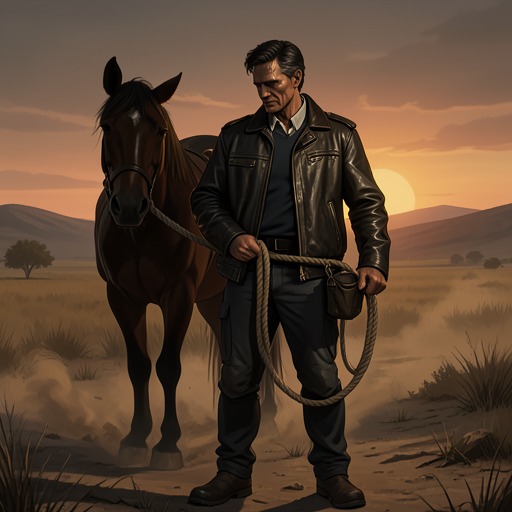
Mr. Croag
Cry MachoMr. Croag is an unlicensed animal-health inspector and Mike Milo’s first employer. His work places him between veterinary care and official condemnation: he inspects and treats livestock, but also decides when animals are to be destroyed. The anthrax outbreak exposes the severity of that authority. When Croag orders the destruction of a herd, Mike refuses to accept the treatment of a healthy yearling as expendable, attacks his employer, and leaves the work behind. Their conflict marks a formative point in Mike’s rejection of a livelihood built around deciding which animals can be saved.
Identity and Background
Croag employs Mike Milo during the summer after Mike’s grandparents die and he quits college. He calls himself a medical man, but he is neither a doctor nor a licensed veterinarian. His actual position is roughly that of an inspector for the animal-husbandry office of the County Department of Agriculture. The gap between his grand professional designation and limited formal credentials is part of his characterization: he exercises consequential authority without the qualifications his title might suggest.
Croag describes the office’s work as inspecting, inoculating, fumigating, and condemning poultry, cattle, and horses. The sequence makes destruction an explicit part of the job, not an emergency exception hidden from view. Croag takes evident satisfaction in naming that final power. His authority is practical and administrative, rooted in the work of identifying disease and directing what is done with animals judged to be affected. It is also starkly consequential: the distinction between treatment and condemnation can determine whether an animal lives.
Work and Private Habits
Mike lives in a back room of Croag’s small house on the outskirts of Fredericksburg. The household offers a glimpse of Croag away from inspections: he is a bachelor who keeps a worn Old Testament in his jacket and knows it by heart. Mike hears him reciting Deuteronomy late at night, in the manner of a stern biblical rebuke. The detail associates Croag’s working severity with a private religious routine, without establishing that one directly causes the other.
Croag’s trade is presented largely through Mike’s apprenticeship. Mike tends the equipment truck, keeps an inventory of chemicals and drugs, cleans testing instruments, sometimes administers injections, and demonstrates fumigants and disinfectants to farmers. He also helps explain how to identify molds, fungi, blights, smuts, lichens, and parasites. Croag’s work therefore involves both inspection and the transmission of technical procedures. The apprentice learns to handle the tools of animal care within an institution that also authorizes the destruction of animals.
The Anthrax Outbreak
Croag’s relationship with Mike reaches its crisis during an anthrax outbreak at a horse ranch about two hundred miles from the county seat. The report comes at midnight, when twenty-two horses have contracted the disease; by the time Croag and Mike arrive at dawn, the number has risen to fifty. The ranch owner sees the horses still standing and takes that as grounds for hope. Croag instead orders that they be shot and the barn burned. His response gives priority to containment and eradication, while the owner’s appeal rests on the visible fact that some animals remain on their feet.
As the work proceeds, the state sends bulldozers and front-end loaders to prepare a large pit for the horses to be burned and buried. Croag initially directs the shooting in the barn, then concludes that the process is too slow. He decides the remaining animals should be driven into the pit and killed there, and hands Mike a gun, telling him to get in. Croag’s methodical shift from one procedure to another presents him as focused on completing the cull efficiently. For Mike, however, participation turns an already troubling job into an immediate moral confrontation.
Conflict with Mike Milo
Mike’s opposition develops from his dislike of the work, which has grown into hatred by the end of the summer. He is deeply affected by animal suffering and questions the arbitrariness with which people exercise power over dependent creatures. He has seen animals that might have recovered destroyed or buried because saving them was considered not worth the expense or time. Croag’s practical standard, as Mike understands it, leaves little room to challenge such judgments. Before the outbreak, Mike has already decided to seek different work; the crisis makes that decision final.
After the sick horses have been killed, a healthy yearling is injured when it panics and falls. Croag prepares to kill it because of its broken leg. Mike distinguishes the animal’s condition from the disease that prompted the cull: it is not sick. He grabs Croag’s gun and throws it away. When Croag goes after the weapon, Mike strikes him; Croag strikes back, and Mike pulls him close and hits him repeatedly. The confrontation is not a dispute over whether the infected herd should be destroyed. Its immediate point is Mike’s refusal to let the emergency’s logic extend to a healthy animal merely because it has been injured.
Aftermath and Narrative Role
Mike never sees Croag again. In the fall, he takes a stock-boy job at Keeley’s Rodeo, doing some roping, wrangling, and steer work; that winter in Oklahoma, he begins bronco riding. The narrative thus places Croag at the end of Mike’s first attempt at employment after leaving college and at the threshold of his rodeo career. Croag does not guide Mike into that new life, but the break with him helps define what Mike will no longer do.
Croag’s role is consequential but confined to this early episode. He embodies an official system in which care, diagnosis, and destruction belong to the same professional routine, and he applies that routine with determination during the outbreak. Mike’s resistance, by contrast, arises from attention to the particular animal before him and from a refusal to treat every case as interchangeable. The clash establishes an enduring fault line in Mike’s experience: the difference between exercising control over animals and recognizing the limits of that control.